I made this (and now you can’t have it)

Half a dozen paintings sit in my studio. Some are finished. Some are portraits still waiting for their eyes, a few are landscapes whose clouds are stuck in their two-dimensional era, and the rest have been abandoned halfway through. The one thing they have in common: they were all meant as gifts for family and friends.
What happens when you can’t bring yourself to start a painting you plan to give away? Or when you finish one and become so attached that handing it over suddenly feels like a terrible idea?
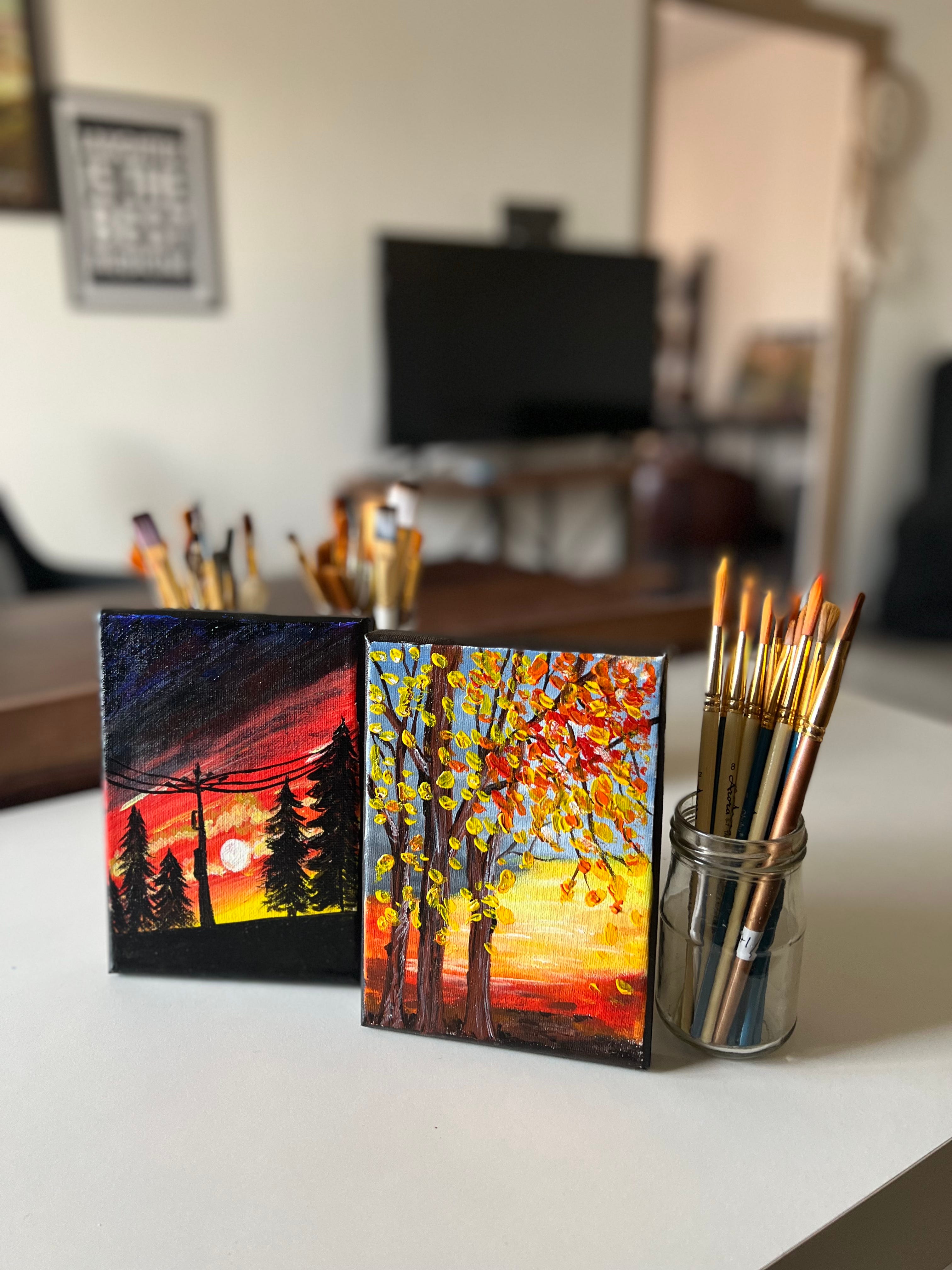
The Blank Canvas Panic.
It all starts here. The sudden onset of artistic amnesia, where you question the right way to hold a paintbrush (like a pencil or at the far edge?). In a split second your brain forgets years of experience and firmly believes you have no idea how to draw a line, or how to mix the right shade of blue for the sky.
The pristine white canvas, meanwhile, is looking suspiciously perfect. Anything your hand does to it feels like irreversible damage. You’ve barely begun and you’re already ruining it.
And then there’s the added pressure of making it for somebody else. A whole other person with their very specific expectation and excitement, is waiting for this painting. Suddenly it’s not just about making something you’re happy with, it’s about whether they will be happy with it too and whether what ends up on the canvas will match the picture in their head. Unfortunately, the ability to see directly into someone else’s imagination hasn’t been included in the artist’s starter kit.
Naturally, you do what every sensible artist in that situation would do - anything except paint.
The Art of Avoiding Art.
Once you’ve convinced yourself the canvas is judging you, procrastination stops being a bad habit and becomes a full studio production.
You arrange your paint tubes in perfect colour order. A third cup of coffee finds its way into your hand. You question the lighting, the position of your easel, and whether you need a better stool. There’s a brief idea of moving the whole studio setup into another room in the house. Maybe inspiration will strike faster when you’ve moved a few feet away.
Then you finally try to do something productive like looking for “colour palette inspiration”, which somehow turns into an eight-part video series of someone building an art supply cabinet under the Brooklyn Bridge, because their apartment has no space. Every episode is watched with utmost concentration as they add another brush holder, a sliding palette rack and heavy-duty caster wheels.
By hour three, not a single brushstroke has been made, but you have an engineering degree in studio woodworking that you never asked for. It’s almost lunchtime anyway, perhaps the light will be better tomorrow.
Or perhaps you’ll remember how to paint tomorrow.
Oh, there you are. I remember why I love this.
Eventually, almost by accident, you make a mark. A reckless messy one, just to break the perfection of the blank surface. It looks terrible (to you), but the silence is broken.
Now the real test of patience begins.
If only you could make one stroke with the brush and have it look like a finished painting. Your sudden impatience to see the end result makes you want to skip the hours of building up layers, adjusting colours and waiting for oil paint to dry and do whatever oil paint needs to do. Somewhere in the back of your memories, your brain tries its best to throw a vague reminder of painting being a therapeutic, meditative process but it gets buried by other thoughts just as quickly.
It doesn’t help when someone sees it before it’s ready. You don’t want them looking at a collection of questionable shapes or blobs of paint and wondering what on earth is happening. Worse, you find yourself trying to explain no, this isn’t what it is supposed to look like; yes, you know that bit looks strange; and no, you haven’t lost the plot. It’s just the first layer.
They probably know that. You know they probably know that. And yet there you are, giving a guided tour of a painting that isn’t ready to be introduced to the public.
The frustrating part is that you know it will all come together. You’ve done this before and you trust yourself to get there. You just wish you could skip the bits in between.
Every. Single. Time.
But somewhere in the middle of all that impatience, something shifts. A shade is adjusted, an edge is softened, a shadow reworked, and gradually the noise in your head begins to fade. The questions about whether they’ll like it, the lighting, the stool and even that cabinet under the Brooklyn Bridge all recede into the background. There is only the painting and the quiet satisfaction of watching it take shape.
The final details bring everything together. A few fine lines along the doorframe, the exact reflection caught in a patch of water, and suddenly the whole canvas clicks into place. What was once a collection of layers, colours and questionable shapes finally begins to resemble the place you had imagined all along.
The only thing that eventually pulls you away is your body staging a protest. Your hand is cramping, your shoulder is questioning the increasingly questionable position you’ve been holding in front of the easel, and you suddenly realise you’re starving and haven’t even thought about dinner.
But none of that matters. The doorframe is straight, the water is wet, and you remember exactly why you do this.
I made this. And now you can’t have it.
The next morning you look at the finished piece on the easel. It turned out well. In fact, too well. By now, you’ve already picked out the exact spot for it on your living room wall. You’ve rethought the colour scheme and planned an entire decor change around it. It’s absolutely essential that this painting stays, because without it, how else will you justify that particular set of cushion covers and the majestic elephant figurine you discovered somewhere?
And then the cold realisation hits you: this one isn’t yours.
If it’s a gift, someone is waiting for it. If it’s for an exhibition, you’re hoping it sells. You’re also, quietly, hoping it doesn’t, so you can take it home where it obviously belongs.
Suddenly, the whole premise feels absurd. Why did you agree to make this for someone else? They don’t know about the artistic amnesia, the eight-part cabinet series, or the guided tour you gave of the first layer. They don’t know how close you came to abandoning it at the third layer, or that you forgot to cook dinner the night you got the doorframe right. To them, it’s a lovely painting. To you, it’s every one of those hours, and the person who got through them.
You start looking for ways out. For the exhibition piece, you consider sticking a little red “sold” dot on it yourself, or quietly marking it reserved in your mental ledger. For the gift, you seriously evaluate how badly you’d burn your bridges if you texted to say it had suffered an unforeseen, tragic studio disaster.
The post-creation hangover
Eventually, one thought makes letting go possible: you know how this one was made. Nothing about it was luck. If you’ve done it once, you can do it again, and maybe better.
It’s a temporary realisation. Probably. But it’s enough.
So you treat the painting with complete emotional coldness and act like it never existed in your life. You pack it up, wincing slightly as the tape seals the box, or hang it on the exhibition wall beside its price tag, and walk away before you can change your mind.
They love it, of course. They admire the details, thank you profusely and hang it on their wall. You smile, say all the polite, modest things an artist is supposed to say, and try not to picture the bare spot at home, the cushion covers, and the elephant waiting for a painting that’s never coming.
Then the hangover sets in. There’s pride, and a quiet, settled kind of happiness. There’s also a small, nagging worry that you’ll never make anything this good again.
You walk back into your studio. The easel is bare. But instead of sadness, there’s a sudden rush of ideas: a new series, new compositions, new colour palettes.
You sit down, look at the brand-new blank canvas leaning against the wall, and think: Never again.
And then, before you can stop yourself, you pick up a pencil and start sketching the next one. It’s meant as a gift, naturally. And somewhere between the pencil and the first line, you remember how to paint.
Discussion about this post