


The first time I was asked to light a deepam at home, I had been married for approximately one hour. We went straight from the marriage hall to my in-laws’ home, where I was expected to light a lamp in the puja room as a newly wedded bride bringing wealth and prosperity into her new family.
I had never lit a deepam as part of a daily puja. In fact, I had probably never struck a matchstick in my life. My parents were so overprotective that even during Diwali, I was handed an already-lit sparkler rather than being trusted with a matchbox. And now, immediately after my wedding, there I was, expected to light a lamp as part of the welcome-home puja, with around twenty relatives standing around watching, some of whom I was meeting for the very first time.
I did it as though I had been doing it every morning of my life. Calmly. Naturally. With the confidence of someone who had apparently received extensive training in the subject. Internally, I was panicking and laughing at the absurdity of it all.
I realise this sounds like an exaggerated analogy for being thrown into a new household, but I genuinely had never lit a matchstick before. Somehow, in the space of getting married, I had gone from being the child whose parents lit her sparklers to the woman expected to perform a whole puja ritual in front of an audience.
Nobody looking at me would have guessed.
I would learn plenty more about rituals, expectations and the many ways a person can look perfectly calm, graceful and composed while internally questioning every life decision that led them to that moment.
But I didn’t arrive at this household without a history of my own.
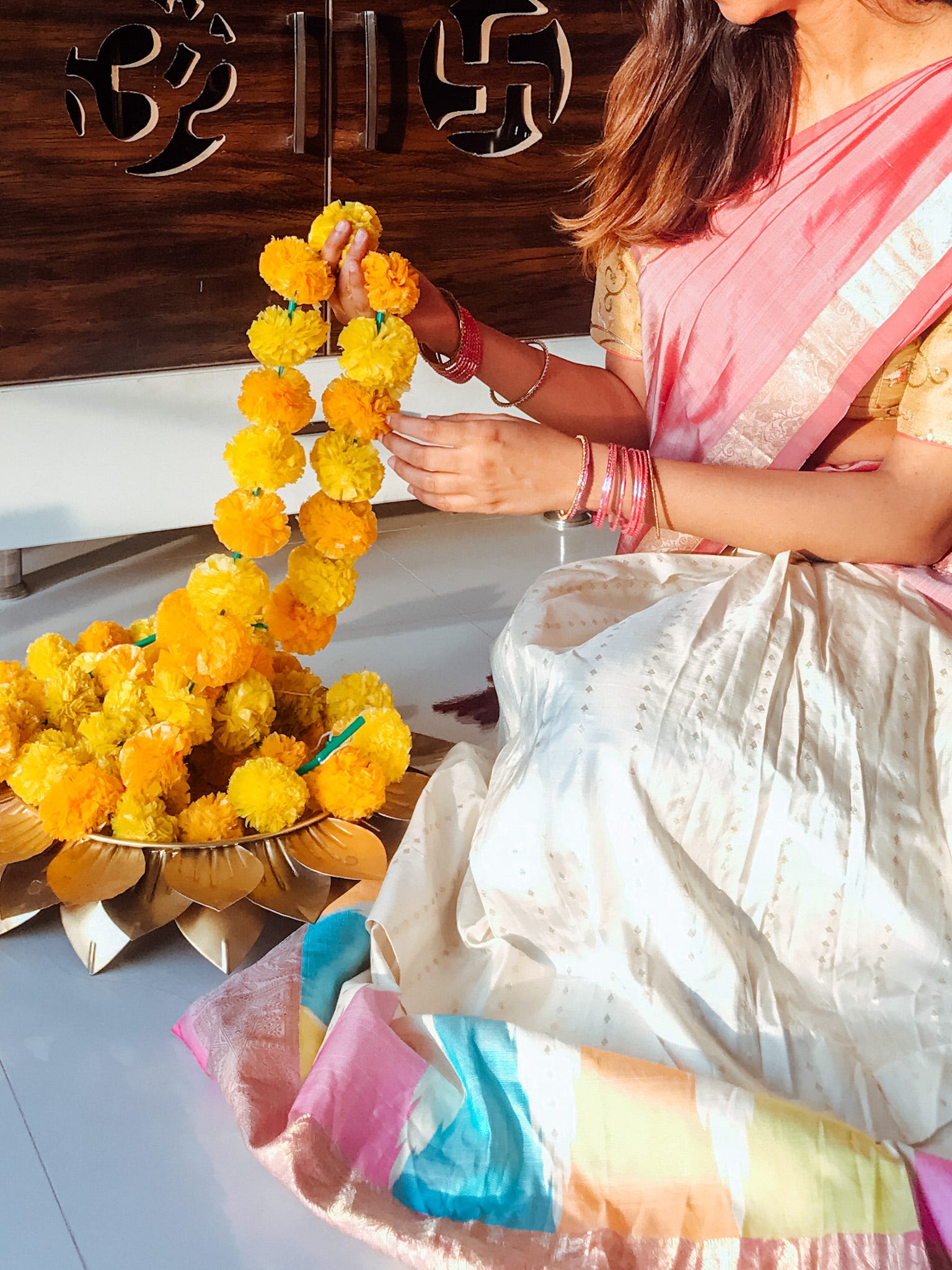
The many ways of believing
I grew up in a joint family, surrounded by cousins and grandparents who had very different approaches to life, belief and spirituality.
My grandparents couldn’t have been on more opposite ends of the spectrum. One was a doctor who believed that service to mankind was service to God, but didn’t believe in any form of God beyond science. Another was part of a satsang community, which, like many others, had its share of questionable believers and non-believers. One grew up with family who were communists, left leaning and everything that came with it, before eventually turning to a human spiritual master as a guru and becoming a writer exploring human emotions and magical realism. And then there was my conservative, traditional Telugu Brahmin grandmother, who believed in her ways but never imposed them on anyone.
My parents, meanwhile, didn’t make religion the centre of our lives. We celebrated festivals, got together as a family, prayed with gratitude, and hoped for good fortune and good health. We weren’t particularly focused on temple visits, elaborate rituals or attaining moksham.
They taught me to be kind, work hard, respect elders and never cheat anyone. Looking back, these are the very same values I associate with the best of religious teachings. My parents taught me a way of living a righteous and rich life without making it explicitly religious.
Growing up, I saw people find meaning in very different places - some in science, some in religion, some in political ideas, and some in spirituality. I don’t think I consciously drew any grand conclusions from all this as a child, it was simply the world I knew. And because it was a joint family, there were other perspectives around me, too. My cousins had their own relationships with the same people, the same household and the same traditions. I wouldn’t assume that we all saw things the same way.
Some of my earliest memories of religion are tied less to the rituals themselves and more to everything that happened around them. Ganesh Chaturthi meant getting ready early in the morning and heading to the market to find the perfectly symmetrical clay Ganesha. The rains would have usually set in by then, and we would battle the heavy morning crowds, weaving in and out of narrow lanes while juggling an umbrella in one hand and trying to finish all the shopping for fruits and flowers, and rushing home while everyone else got the mandapam ready. The whole thing had a festive energy that was as much about the preparation and the food as it was about the puja. Nobody was policing us for sneaking a mouthful of the freshly made payasam before the puja was over.
Diwali was about decorating the house until it looked lit up, dressing up until we looked equally lit up, and taking far too many family photographs while crackers went off around us. Lakshmi puja would be happening in the background with my grandmother while the rest of us were busy frolicking, posing and generally enjoying ourselves.
The rituals were there, but they weren’t the entire event. They were part of something bigger: family, food, anticipation and the happiness of doing things together.
I didn’t grow up thinking of religion as something I had to accept or reject in its entirety. I went through phases of believing in God, not believing in God, questioning the purpose of it all and calling myself “spiritual but not religious” without entirely knowing what I meant by that. What I did know was that I didn’t like conforming simply because something was expected of me.
Looking back, I'm grateful that my family never made me feel like I had to arrive at a particular answer about faith. They didn't impose their beliefs or expect me to follow rituals simply because that was how things were done. They let me question, change my mind, fumble around and find my own way, without making me feel that I was getting it wrong. I don't think I appreciated just how much freedom there was in that until I grew older.
I also didn’t yet know how much more complicated that feeling would become when the expectations came from people I loved, in a household I was now part of.
The ideal couple, and the couple that actually exists
Marriage introduced me to a household where religion and rituals had a much more structured place in everyday life. There was a reason behind why things were done, a particular way to do them, and often a strict order in which they needed to happen. These practices were connected not only to the well-being and good fortune of the family, but also to ideas of karma, accumulating punyam and eventually attaining moksham. Everyone was expected to follow them in the same way.
What took me the longest to understand is that, for them, there was no deeper reasoning to uncover. The rituals were done because they protected the family’s well-being, because they earned punyam, because this was simply the right way to do things. There was no preference behind it to negotiate with. As far as they were concerned, they were handing me something valuable, which is precisely what made it so hard to question.
I was being introduced to practices I had never known or grown up with, and there is a difference between being introduced to something that’s meaningful to another person and being expected to make it your own. Some things were enforced, but perhaps the strangest adjustment was discovering just how much of married life seemed to come with a set of instructions.
Take the vratams performed for the health and well-being of a husband. The stories associated with some of these observances describe extraordinary devotion: a wife so pious and dedicated in her observance that she can challenge death itself, change the minds of the Gods and bring her husband back from the brink of an ending that should have been inevitable.
These are not small expectations to live up to. In the stories, the husband and wife can be understood as embodiments of Shiva and Parvati, the ideal couple, two halves of a whole. Their devotion to each other is extraordinary, and their relationship seems to operate on a plane that the rest of us can only aspire to.
And then there is the modern married couple.
One person is expected to wake up at six in the morning, prepare everything for the puja, get the details right and do it all under the watchful eye of a strict mother-in-law. The other person is snoring away to glory, blissfully unaware that his well-being is currently the subject of a considerable amount of early-morning activity.
Well, we are not Shiva and Parvati - not even close. We are two bumbling idiots trying not to get annoyed with each other before breakfast and trying to navigate marriage alongside everything else life throws at us. And that means sometimes we work something out together, and sometimes we both decide that we have had enough and quietly try to find a way out of the rituals.
The thing is, it took us years to get here. Years to understand ourselves, each other, and what religion and rituals meant to us individually and as a couple. Years to figure out how to navigate the awkward situations that arise when what is expected of us doesn’t quite fit the people we actually are.
He makes excuses for me when it helps, and there are times when it’s easier for me to give in. But he also puts his foot down when things get unreasonable. In sweltering heat amidst chaotic puja preparations, he has insisted there’s no need to add another layer of problem (quite literally) by wearing heavy silk sarees, insisting I show up in a simple churidar instead, he sneaks me some breakfast on days when the preparations stretch until eleven in the morning and lunch looks unlikely before three, there have also been days when we’ve decided to show up, offer our prayers and leave, rather than spend yet another entire day at a festival. There is certainly no shortage of festivals and pujas in our culture, and we were slowly learning that participating didn’t always have to mean giving up the whole day.
It isn’t a particularly grand or heroic form of marital solidarity. There are no Gods being persuaded, no impossible feats of devotion, and no dramatic declarations of eternal commitment. There is just the slow, occasionally frustrating process of learning how to have each other’s backs.
But it matters.
Because the expectation of a wife performing a ritual for her husband’s well-being can look rather different when the husband is also involved in helping her navigate that expectation. The ritual may have begun as something she was encouraged, or expected, to do. What happens next becomes part of the couple’s own story.
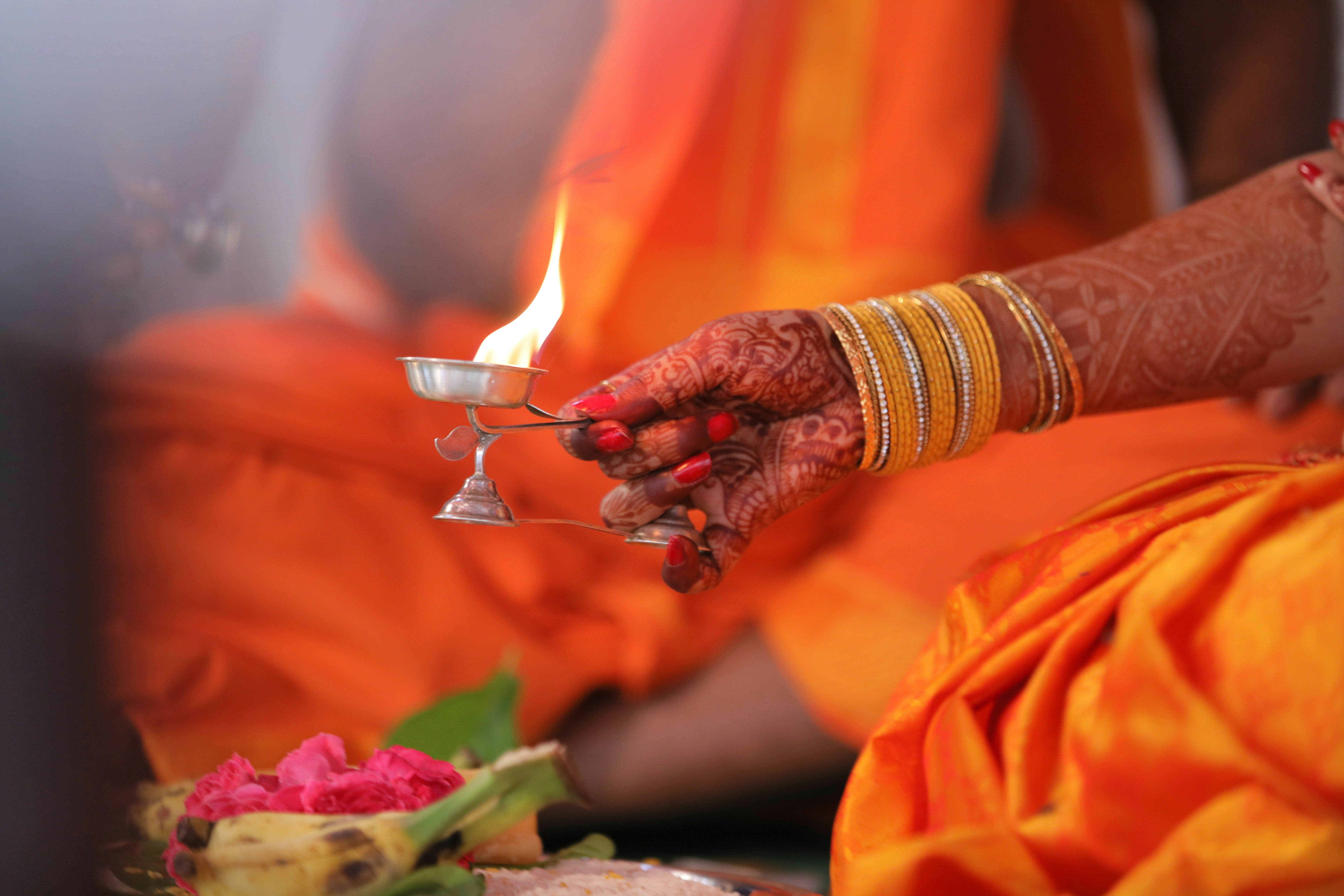
The flowers, the hair, and everything in between
Of course, not every ritual comes with a story about defying death. Sometimes the issue is much more ordinary.
The flowers have to be arranged a certain way before a puja. Your hair is supposed to be worn a certain way. Only certain kinds of bangles are to be worn. There is a particular order in which things must be done. You learn that it isn’t simply a matter of doing the thing, it is a matter of doing it correctly.
And there is always someone who knows what correctly looks like.
I can understand wanting a ritual to be performed with care, and why a particular order or practice holds meaning for someone. Sometimes the instructions are genuinely helpful, and I appreciate being taught something I never knew. But there is a difference between being shown how something is done and feeling monitored while you do it. Under that kind of watching, I find myself concentrating so hard on getting everything right that I lose sight of what I am doing it for, and I start to wonder whether the details are serving the ritual or whether getting them right has become the ritual itself.
And sometimes I am just annoyed that I cannot arrange a few flowers without it becoming a whole thing.
Perhaps that’s where the difference lies for me: I can appreciate the intention behind a practice without agreeing that every detail must be followed to the letter, regardless of who is following it and in what state.
What I believe now
For all my questioning, I do believe in God. My faith gives me a sense of grounding, a reminder that not everything needs to make sense to me, and not everything is mine to control.
I remember standing in Somnath and being washed over by a feeling of peace, a sense of belonging. I felt like I could stay there for hours, that every problem in my life would somehow find a solution, and that nothing else mattered in that moment. I don’t know how to explain that feeling, and I don’t think I need to. It was enough to experience it. Looking back, what strikes me is everything that moment didn’t have: no correct order, no one watching, nothing to get right. Perhaps that is the part of faith I trust most, and the part that is hardest to find in a house full of instructions.
At the same time, belief hasn’t made me unquestioning. I can find meaning in a ritual and still feel uncomfortable with the expectations around it. I can respect the faith behind a practice and still question whether it needs to be performed by everyone in precisely the same way.
I have learnt to say no to some things, although I haven’t entirely learnt how to do it without guilt. I still wonder whether I’m disappointing someone, being unnecessarily rigid, or simply trying to protect my own peace.
And then there’s the question of why I say yes. Am I participating because I believe in the practice, because it matters to someone I love, because I want to keep the peace, or because I simply don’t have the energy for another disagreement? Trying to distinguish between these motivations can become a whole mental exercise in itself, with no prescribed order and absolutely no guarantee of reaching a satisfying conclusion.
So, when does a tradition become an obligation?
I don’t think the answer lies in deciding whether tradition is good or bad, whether religious people are too rigid, or whether questioning a practice makes someone less respectful. The same ritual can bring one person peace, another a sense of community, and someone else a feeling of pressure.
What I haven’t worked out is which of those I’m feeling at any given moment. Some days I light the lamp because I believe in it, and some days because it is easier than the conversation that would follow if I didn’t. From the outside, both look exactly the same. Perhaps there isn’t an answer to settle once and for all. It probably changes with the tradition, the people involved, the circumstances, and the version of myself that happens to show up that day.
And I am fairly certain that if Shiva and Parvati had to navigate a modern marriage, a joint family, an early-morning puja and a husband who wouldn’t wake up on time, even they might need to renegotiate a few things!